
Issue 60
March 2026

Building Coastal Futures: Attending the Estuary Management Course hosted by Nelson Mandela University

During March the LBRCT Manager, Jason Oxley, attended an accredited short learning programme on the Management of Estuaries in South Africa. The course was run by the Institute for Coastal and Marine Research of Nelson Mandela University and the Western Cape Government and was hosted by the Overstrand Municipality. CSIR provided support in preparation of course material and contextualizing the local case study, the Klein Estuarine Lake. The course took place from 3rd to the 5th of March in Hermanus with 51 participants and 14 presenters attending. Other collaborators and presenters at the course were from the DWS, DFFE and CapeNature. The course was aimed at estuary RMA (Responsible Management Authority) officials as well as others interested and involved in the development of Estuary Management Plans and monitoring techniques. The three days included intense lecturing and discussions as well as an afternoon field trip.
The course content included:
(1) Provincial management of estuaries
(2) Estuary Rehabilitation
(3) Value, structure and function of estuaries
(4) Estuary health and the National Biodiversity Assessment
(5) Harmful Algal Blooms and Invasive Alien Aquatic Plants
(6) Invertebrates & birds as indicators of estuary health
(7) Estuary legislation and ecological water requirements of estuaries
(8) Estuarine fish & fisheries: research, monitoring & management
(9) Estuary Management Plans, mouth & maintenance management plans
(10) Implementation of water quality management in estuaries
(11) Estuary monitoring including citizen science programmes, restoration & monitoring
(12) Remote sensing tools for estuaries (OCIMS)
(13) Increasing estuary protection, restoration and management successes – learning by doing
(14) Implementation of Estuary Management Protocol – National Level Progress and Way Forward
(15) Provincial Level Progress and Way Forward
(16) A field trip to the Klein Estuary.


We were also visited by the Overstrand Municipality’s Executive Mayor, who thanked and commended participants and presenters for the work that they do.
Snake and Animal Rescues:
2 Sandwich Terns
1 Spotted Eagle-owl
2 Cape Cobras
1 Brown House Snake
3 Juvenile Boomslangs
1 Blue Crane
2 Angulate Tortoises
1 Loggerhead Turtle

Join the LBRCT Community using our Cell Phone App!

Signs displaying scannable QR codes for Day Permits and the new Mobile Communications App have been installed underneath the existing Malgas area signs.
With the LBRCT added as a community on the GLO CMS app, you can explore the content for useful information relating to fishing, boating and important regulations. Be sure to click on the more button for additional links.
The app has many features which will be used to keep you informed and up to date with special events, stakeholder engagements, annual meetings, and important notices.
Apple App Store - https://apple.co/4cgCLeF
Google Play Store - https://bit.ly/3Egtgj7
Huawei App Gallery - https://bit.ly/429FORq
Blinded by the Light: The Dangers of Light Pollution for Wild Animals
Light pollution - excessive or misdirected artificial light at night - has become a growing environmental concern, with far-reaching consequences for wild animals. While it may seem harmless or even beneficial for human activity, artificial lighting disrupts natural ecosystems in ways that can be both subtle and severe.
Many species have evolved over millions of years to depend on natural light cycles governed by the sun, moon, and stars. When these cycles are altered, animals can become disoriented. Nocturnal animals are especially vulnerable. Creatures such as bats, owls, and certain insects depend on darkness for hunting, feeding, and avoiding predators. Artificial lighting can expose them to danger, reduce their ability to find food, or force them to abandon otherwise suitable habitats. Insects, in particular, are drawn to lights, often fatally, which disrupts food chains since many other animals rely on them as a primary food source.
Light pollution also interferes with reproduction. Beyond individual species, these disruptions ripple through entire ecosystems. Changes in predator-prey relationships, altered feeding patterns, and declining populations can destabilise biodiversity.
Addressing light pollution doesn’t require complete darkness but smarter lighting—using lower intensity, shielding lights downward, and reducing unnecessary nighttime illumination. By aligning human practices more closely with natural cycles, we can help protect wildlife and preserve the delicate balance of ecosystems.
Breede River Locations Map
Click here to view a map of the Breede River Estuary containing the locations of popular spots, attractions, restaurants & pubs, accommodation, boat licence sales outlets, public slipways, and more!
Rapid Response Rescues Stranded Loggerhead at the Breede River Mouth

On the morning of the 17th of March at 08:45, the Lower Breede River Conservancy Trust (LBRCT) received an urgent call reporting a large turtle stranded on the Witsand main beach near the mouth of the Breede River. Acting swiftly, the team immediately alerted the turtle rescue hotline and mobilised a response.
Equipped with a canvas carrier, LBRCT staff members Tertia, Jason, Luton, and Gershwin reached the scene within 15 minutes, where they discovered a very large female loggerhead turtle. Despite being visibly strong, the turtle was covered in wounds and parasites, highlighting the urgency of the situation.
Thanks to efficient coordination, Tracy from Two Oceans had already arranged transport, and the teams successfully met at the N2 by 10:20 to transfer the turtle to the conservation centre at the aquarium for further care and rehabilitation.
The rescue reflects the power of quick action and collaboration in protecting marine wildlife. The team now awaits updates on the turtle’s condition, and is hopeful for a full recovery.


Making a Difference Through Education

During March, the LBRCT rangers had the opportunity to visit Slangrivier and Ouplaas Primary Schools, where they engaged with learners about the importance of protecting the endangered and vulnerable animals of the Breede River Estuary. To support the learners further, we also donated sports balls and stationery to the schools. Together, we’re inspiring the next generation to care for our environment and protect our natural heritage.
Should you wish to support future school visits, we would be incredibly grateful. The LBRCT is a registered NGO and PBO and can issue tax certificates for donations.
For more information, please contact us:
 info@breede-river.org
 WhatsApp: 064 774 3862


Avian Influenza (Bird Flu) in Western Cape: Public urged to stay alert, not alarmed.
Since early July 2025, a new outbreak of high pathogenicity avian influenza (HPAI) has been confirmed in wild seabirds across the Western Cape. These are the first wild‐bird detections in the province since April 2024. Wild seabirds infected with HPAI often develop neurological signs such as tremors, head twitches and seizures. Although HPAI occasionally infects mammals and humans, the risk to the public remains very low when basic precautions are followed. Members of the public are encouraged not to touch sick or dead birds and to report them to the LBRCT.
What is High Pathogenicity Avian Influenza?
High pathogenicity avian influenza (HPAI), also known as bird flu, is a viral disease that causes rapid, severe illness in birds. The type of HPAI affecting seabirds in South Africa is officially known as H5N1 clade 2.3.4.4b.
Which birds have been affected?
At the beginning of August 2025, most of the affected wild birds were Hartlaub’s gulls. Cases have also been reported in Great white pelicans, Grey-headed gulls, Kelp gulls, Whitebreasted cormorants, Crowned cormorants and Sacred ibises. Domestic chickens and ducks have also been affected.
Buy your Recreational Fishing Permit online:
Recreational Fishing Permits are available online. Please visit https://www.fishing.dffe.gov.za/ to purchase your permit.
Please remember that should you intend on fishing from a vessel, at least one crew member requires the permit condition for an "additional fee per vessel for recreational fishing from such vessel" to be selected.


Grab your Fish Measuring Sticker for Free!
Visit our office in Witsand to collect a free fish measuring sticker for checking minimum size and bag limits of common fish and bait species.

Legal Size Red Flags for Water Sports
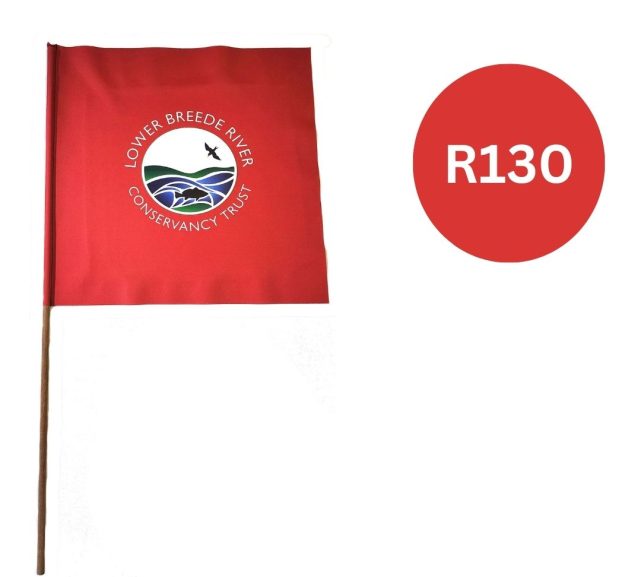
As per the municipal by-law, the operator of a boat towing a skier must display a red flag measuring a minimum of 500mm by 500mm to indicate when:
(a) a skier is down in the water, or preparing to ski;
(b) a tow line extends from the boat;
(c) a ski is in the water in the vicinity of the boat.
To purchase a legal size LBRCT red flag for only R130 please contact info@breede-river.org or WhatsApp 064 774 3862 to place an order.
Buy a Conservancy Cap
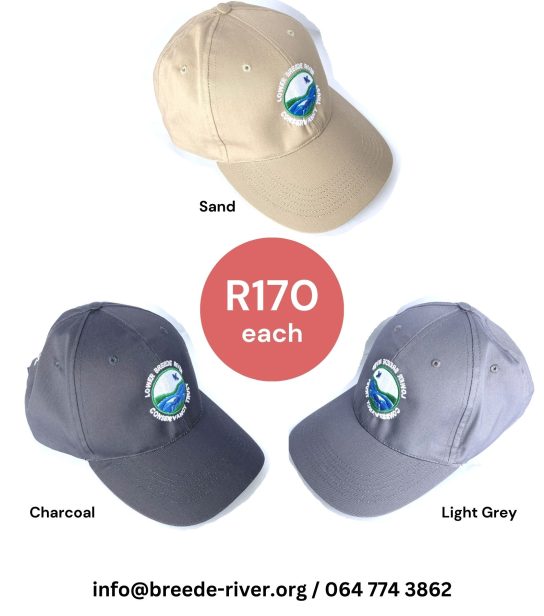
Are you a member of the LBRCT?
If you take an active interest in, or use the Breede River Estuary, we encourage you to become a member of the LBRCT and support our worthwhile endeavours on your behalf by way of contributing to these efforts. Memberships are due for renewal from the 1st of July 2026.
If you are interested in receiving news updates and other interesting information join our 'LBRCT Communications' WhatsApp group.
Click here to join the group.
Like what we're doing?
Leave us a review: